
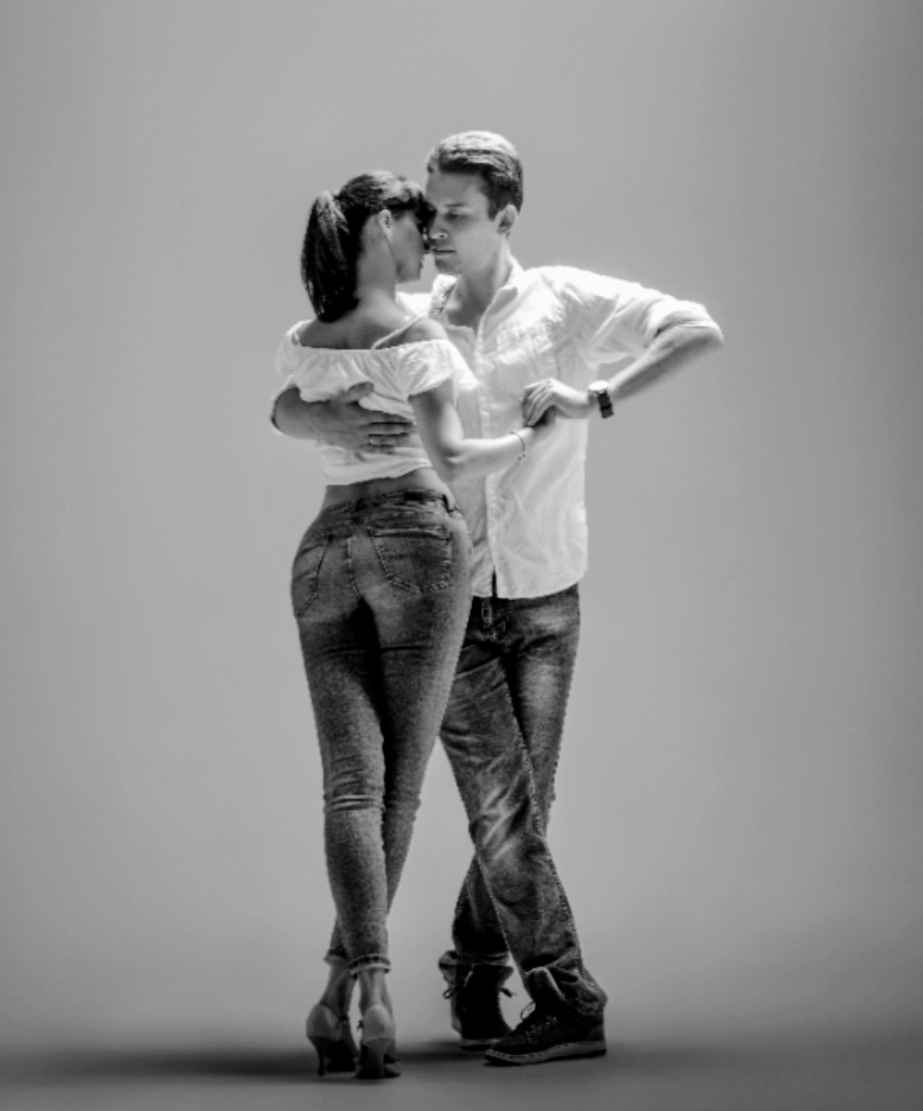
DANCE STYLES EXPLAINED
Kizomba & Bachata Dancing - what is it?

Kizomba
-
Written by Emma.
Kizomba is both a musical genre and a dance form that originated in Angola (on the southwestern coast of Africa) in the late 1970s and early 1980s. Kizomba (pronounced Kee-zOm-ba, not Ki-zUmba!) is not related to the aerobic fitness programme ‘Zumba’ in any way. Angola, a former Portuguese colony, has a vibrant music scene, and Kizomba blends African rhythms with Angolan Portuguese lyrics. The word Kizomba comes from the Kimbundu language (one of the Bantu languages spoken by the Mbundu peoples in Angola) and means Celebration. The Angolan government is currently seeking UNESCO recognition for Kizomba as Intangible Cultural Heritage to protect and promote Kizomba, which is considered a significant expression of national cultural identity in Angola.
The music of Kizomba is often described as ‘hypnotic’ due to its slow and steady rhythms, looping melodies and focus on percussion. The rhythmic structure of the music, combined with the smooth, calm, grounded movements of the dance, creates a flowing and immersive experience. It is the perfect dance for anyone who would like to learn to dance gently and slowly with a partner. The music has an obvious beat, making Kizomba ideal for those new to dancing. At the same time, the subtle and finely tuned lead/follow that allows improvisation is a great challenge for more experienced dancers.
A little bit of history: During the Angolan War of Independence (1961–1974), Portuguese colonial authorities enforced extensive cultural repression through violence, including censorship and prohibitions on traditional music, communal gatherings, and singing in Kimbundu. These measures aimed to suppress Angolan cultural identity and resistance, powerfully conveyed through their music. Angolan musicians who demonstrated anti-colonial sentiments frequently faced deportation and forced labour. The suppression efforts solidified Angolan music’s role as a powerful symbol of resistance, contributing to the development of urban music within the communities of displaced individuals. Musicians composed works about the realities of colonial exploitation and utilised their Kimbundu language to conceal critical messages from Portuguese officials. José Adelino Barceló de Carvalho, known as Bonga, an Angolan folk and Semba singer-songwriter, was a prominent musician of the time.
The Angolan Civil War (1975 – 2002) created a context where Kizomba emerged as a way for people to connect, find comfort, and preserve their cultural identity. Eduardo Paím is an Angolan singer considered one of the creators of the Kizomba musical genre, and the dance evolved from other Angolan dances such as Angolan Semba (see Samba, another dance with roots in Angolan Semba), Angolan Merengue, and Kilapanga (a tradition of the Bakongo people from Angola and the Congo). Kizomba was further influenced by Caribbean Zouk music (a tropical dance music) after the French Caribbean group Kassav visited Angola and other regions of Africa in the 1980s.
Eduardo Paím is an Angolan singer considered one of the creators of the Kizomba genre. Kizomba spread to Europe through Angolan communities who migrated to Portugal to escape the Civil War. They established Kizomba as a central part of their social life in Portugal, especially in Lisbon. Angolans now form the second-largest foreign community in Portugal, and major Kizomba festivals are held annually in Lisbon, which attract dancers from around the world. Kizomba is now popular in the UK, France (especially Paris), Spain, other European countries, and North America, as one of the social or Club Latin dances alongside Salsa and Bachata, and the dance has evolved as it spread.
Please note: If you look up Kizomba videos on YouTube, you may notice dancers performing intimate hip movements. Intimate hip movements are not part of Kizomba. They are movements and trends from other dances, such as the Angolan Tarraxhina/Tarraxa/Tarraxo or Haitian Kompa/Konpa (click here for an example of Tarraxhina). Kizomba does have a close connection, but it is also family-friendly. You can dance expressively with your hips and your core without it being intimate in nature. It is crucial to dance with care, respect, and awareness of other people’s boundaries, regardless of how you perceive the dance. While Tarraxhina and Kompa are stunning dance styles, we do not teach Tarraxhina or Kompa moves in our classes.
There are a three main styles of Kizomba danced globally:
Traditional Kizomba: The original form, as danced in Angola, is characterised by circular and grounded movements and can be danced to slow, medium or fast music - the faster styles closely resembling Semba.
Urban Kiz: Often called ‘The French Style’, Urban Kiz looks and feels very different to the original Kizomba. It has linear lines (instead of circular) and a looser partner connection. Urban Kiz draws on many dances, from Hip Hop, Argentine Tango, and Tarraxhina.
Kizomba Fusion: This is the style we teach, and it lies somewhere between Traditional Kizomba and Urban Kiz. It is danced to slow-to-medium tempo music, uses the same circular movements and grounded movements as Traditional Kizomba, but has a gentle influence from other dances. In our classes, we lean more toward Traditional than Fusion. It can be danced simply and elegantly, with a little bit of flow and wiggle, or with more flow and wiggle – the choice is yours!
-
Examples of Kizomba music, available on YouTube:
-
Educational and dance history videos available on YouTube:
YouTube - Kizomba demo by Mário Jordão, Angolan dancer & National Champion of Kizomba and Semba 2015
YouTube - Explore Angola: Kizomba music helps renew Angola's cultural identity
YouTube - Angola’s modern music: Kizomba & Kuduro, CGTN Africa
YouTube - Kizomba Fusion as danced by Isabelle & Félicien (European)
Please note: If you look up Kizomba videos on YouTube, you may notice dancers performing intimate hip movements. Intimate hip movements are not part of Kizomba. They are movements and trends from other dances, such as the Angolan Tarraxhina/Tarraxa/Tarraxo or Haitian Kompa/Konpa (click here for an example of Tarraxhina). Kizomba does have a close connection, but it is also family-friendly. You can dance expressively with your hips and your core without it being intimate in nature. It is crucial to dance with care, respect, and awareness of other people’s boundaries, regardless of how you perceive the dance. While Tarraxhina and Kompa are stunning dance styles, we do not teach Tarraxhina or Kompa moves in our classes.
Bachata
-
Written by Emma.
Bachata is both a music genre and dance style, originating in the Dominican Republic. The word Bachata is used in a Caribbean Spanish dialect, which is in turn derived from the African word cumbancha or cumbacha, meaning party or gathering. Dominican Bachata was declared Intangible Cultural Heritage of Humanity in 2019 by UNESCO.
Bachata music has a warm, tropical, romantic tone, is traditionally played on the guitar, and features lyrics that express heartfelt emotion and storytelling. The music has an obvious beat, which makes learning Bachata ideal for those who are new to dancing. The dance is gentle, encouraging smooth, expressive movement through the hips, torso, and shoulders, and gently enhancing flexibility while having fun!
A little bit of history: Bachata originated in the Dominican Republic in the early 20th century, during the brutal 31-year dictatorship (1930–1961) of Rafael Trujillo. Bachata stems from the poor, mixed heritage, Afro-Dominican, and Indigenous (Taino/Arawak) communities of the Dominican Republic, and the music’s beauty and lightness are a harsh contrast to the terror and massacres of the time. Due to Trujillo's obsession with race, and the classism and racism of middle/upper-class Dominicans, Bachata music and dance were banned and censored. They thought its humble roots and lyrics were immoral and distasteful, so the government promoted Merengue instead. Despite suppression, Bachata continued to be played and danced in the poorer communities. After Trujilo’s assassination in 1961, the song Barracho de Amor by José Manuel Calderón, was recorded in 1962, and is recognised as the first recording of Bachata music.
Bachata still had to fight for acceptance and popularity, and it wasn’t until the early 1990s, when Juan Luis Guerra’s album Bachata Rosa won a Grammy for Best Tropical Album, that it gained mainstream acceptance in the Dominican Republic. Bachata Rosa helped popularise Bachata music worldwide, and musical artists like Elvis Martínez, Raulín Rodríguez, Antony Santos, and Luis Vargas also played vital roles in the genre's growth.
Bachata is now enjoyed worldwide as one of the most popular dances in the Latin-American dance community, alongside Salsa. Its global rise has brought modern influences to its music and dance. The significant Dominican population in New York, many of whom settled there after Trujillo’s death, laid the foundation for Bachata music and dance in the city. This cultural presence has fostered a dynamic and active social dance environment, with many venues, dance schools and events dedicated to it. Aventura, an American Bachata band from The Bronx, New York, but with Dominican heritage, helped pioneer the modern Bachata sound. They were the first major Bachata act to originate in the United States rather than the Dominican Republic.
There are a few main styles of Bachata dancing:
Dominican Bachata: Dominican (or Traditional) Bachata is the original form of Bachata, as danced in the Dominican Republic to Dominican Bachata music. It features playful, complex footwork and is a stunning dance!
Bachata Moderna:We teach Bachata Moderna in our classes. It is inspired by Bachata music, as well as covers and remixes from other countries. Bachata Moderna was pioneered by a dancer called Juan Ruiz. It is a lovely dance style which flows and turns. We also incorporate elements from Traditional, Sensual and BachaTango to suit the music as it ebbs and flows!
Sensual Bachata: Sensual Bachata originated in Spain and was developed by dancers Korke Escalona & Judith Cordero. Sensual Bachata focuses on very slow movements and isolations to highlight an intimate connection between the dancers, and is influenced by Zouk and Contemporary dance.
BachaTango: BachaTango is a contemporary style that integrates elements of Bachata with Tango. It takes a theatrical, performance-focused approach.
-
Examples of Bachata music, available on YouTube:
-
Educational and dance history videos available on YouTube:
YouTube - Music and dance of Dominican Bachata, produced by UNESCO
YouTube - Bachata music by Academia de Bachata - a collaborative venture between iASO Records and The DREAM Project, an educational NGO that provides holistic education to more than 15,000 at-risk youth in the Dominican Republic.
YouTube - Romeo Santos (previously of Aventura): A Global Superstar
YouTube - Traditional Bachata of the Dominican Republic - danced to fast music
YouTube - Traditional Bachata of the Dominican Republic - danced to slower music
YouTube - Sensual Bachata as danced by Korke Escalona & Judith Cordero
YouTube - BachaTango as danced at the Bachaturo Festival, Poland