
DANCE STYLES EXPLAINED
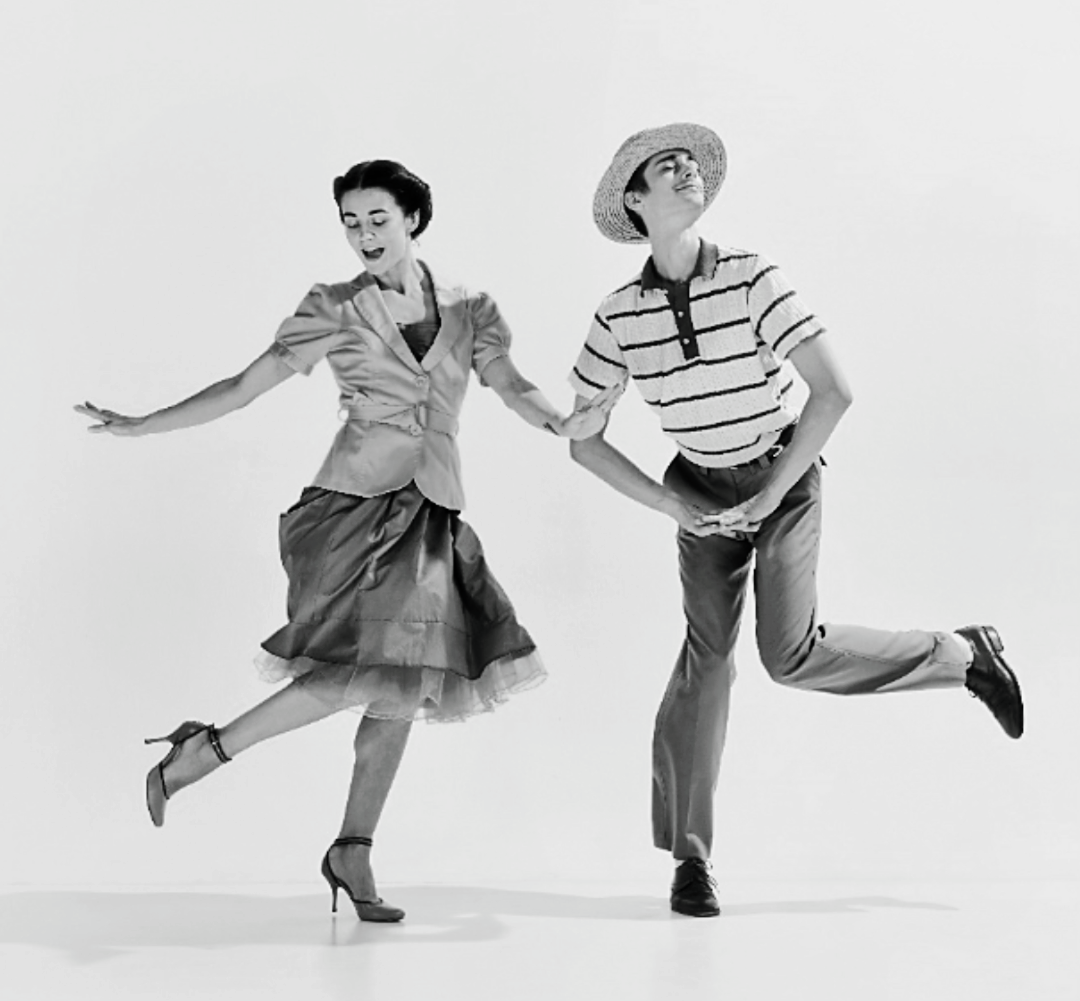
Vintage dancing - What is it?

Swing (Lindy Hop)
-
Written by Emma.
Swing dance is any dance performed to swing music, a style of jazz with a swinging beat. A swinging beat, or swing rhythm, is where the pulse is divided unequally and alternates between long and short durations. Swing dance is often associated with the Big Bands of the 1930s and 1940s and social dances of the Second World War. There are many types of swing dance, and in our Vintage classes, we teach Lindy Hop as our chosen swing dance. Lindy Hop is fun, playful and dynamic! It has an 8-count rhythm at its core, but also includes 6-count rhythms. As a performance style, it can be energetic and acrobatic, but our dance classes focus on its smooth, rhythmic moves suitable for social dancing. We also teach some famous solo dances (known as ‘strolls’), such as the Shim Sham.
Origin: A blend of older musical genres (such as blues, gospel and spirituals, ragtime, stride piano, and the traditions of New Orleans brass bands) led to the creation of Hot Jazz in New Orleans (aka Dixieland Jazz or Traditional Jazz) which became popular in the late 1920s and 1930s, through the musical works of Buddy Bolden, Jelly Roll Morten and Louis Armstrong. The 1920s are often called the Jazz Age. Hot Jazz travelled to northern cities, such as New York, through the Great Migration, vaudeville tours, radio and the gramophone, and then evolved into the more arranged, smoother sound of Swing (another form of Jazz, originally known simply as Jazz or Big Band Jazz) in the 1930s and 1940s (known as the Swing Era or Big Band Era). New York City orchestras popularised Swing music and the Lindy Hop originated in the African American communities of Harlem, New York, in the late 1920s and 1930s, in response to these music genres. It evolved from a fusion of dances, including the Texas Tommy, Charleston, Tap, Breakaway, and other vernacular jazz styles. These dances are rooted in rhythmic West African dance, music, and culture, which travelled to the Americas through the transatlantic slave trade.
Early influences: The Texas Tommy was a vigorous partner dance of the 1910s, and the Charleston, a vernacular jazz style, was a lively dance popular in the 1920s, known for its energetic kicks and swinging arms. Vernacular jazz dance is not the same as modern/stage jazz—it refers to a dance style that emerged from African American communities in the late 1800s, with movements inspired by everyday life. Tap focused on rhythmic footwork, and Breakaway emphasised short moments of breaking away from your dance partner to allow for solo expression and improvisation. A prominent Harlem dancer, George Snowden (known as Shorty George), is credited with introducing the Breakaway dance form to the mainstream. He famously featured in the 1929 film After Seben, dancing Charleston with Breakaway moves, which helped popularise the style and led to the development of Lindy Hop, with breakaway moves such as the swingout. The term Lindy Hop was thought to be inspired by the excitement of the 1927 solo transatlantic flight of Charles Lindbergh, an American aviator.
The Savoy Ballroom: Lindy Hop developed in an incredibly glamorous venue: The Savoy Ballroom in Harlem, New York (open from 1926 to 1958). The Savoy Ballroom, known as the heartbeat of Harlem, was owned by Moe Gale and Jay Faggan, and managed by African American Charles Buchanan. This ownership structure was notable as one of the first racially integrated public venues in the country. Buchanan once said, "At the Savoy, you’re judged by your dancing, not your colour”. Their commitment to an unsegregated dance floor, that presented music and dance without racial exoticism, made it a key feature of the Harlem Renaissance, a vibrant movement spanning the 1920s and 1930s during which African American artists, writers, musicians, and intellectuals started to redefine and solidify African American identity. Harlem became a hub of creativity and self-expression, with jazz, poetry, and dance at its core - a testament to the power of music and dance to bring people together and transform society. The Savoy Ballroom was a community-oriented establishment and its low admission fees made it an affordable and vital refuge for people looking to escape the difficulties of the Great Depression, which began in 1929. The ballroom employed two bands that would play on alternating bandstands to ensure the music never stopped, and hosted major jazz orchestras such as Chick Webb's Orchestra, Al Cooper's Savoy Sultans, Louis Armstrong, Count Basie, Duke Ellington, Ella Fitzgerald, Benny Goodman, Erskine Hawkins, Fletcher Henderson, Billy Holiday, King Oliver, and many more! These orchestras would play a variety of ballroom music, but mostly jazz/swing. The venue was famed for its thrilling "battle of the bands" events, the most memorable of which were said to be Chick Webb's victory over Count Basie, and again Chick Webb’s victory over Benny Goodman! Edgar Sampson composed the Savoy Ballroom's anthem, Stompin' at the Savoy, in 1934.
Improvisation: The environment at the Savoy Ballroom encouraged a vibrant interplay between musicians and dancers, providing a public platform for African American skill and musicality. Cat's Corner was a specific spot on the dance floor where the most talented dancers showcased their skills, and there was an unwritten rule against copying each other's steps, which fostered creativity, inventiveness and improvisation. The well-known first-generation Lindy Hoppers of the late 1920s were George Snowden (Shorty George), George Ganaway (Twistmouth George), Big Bea, Little Bea, and Leroy “Stretch” Jones, with Shorty George regarded as the most skilled. In the mid-1930s, a new generation of Lindy Hoppers favoured acrobatic air steps and throws, developing the style away from earthbound floor steps, simpler lifts and small jumps. These dancers were known as Whitey’s Lindy Hoppers after their manager Herbert “Whitey” White, a bouncer at the Savoy Ballroom who recognised the dancers' skills as a business opportunity, and they toured America and Europe. Some of these dancers included Frankie Manning (who danced the first Lindy Hop air step with Frieda Washington circa 1936), Ann Johnson, Al Minns, Leon James, Norma Miller, Willa Mae Ricker, Sandra Gibson, Joe Daniels, Joyce James, and Alfred Pepsi Bethel.
Development: Swing music began incorporating elements of Boogie Woogie music in the late 1930s. Benny Goodman, known as The King of Swing, recorded Roll 'Em in 1937, which had a boogie feel, and collaborated with Boogie Woogie pianists Meade “Lux” Lewis and Albert Ammons. It was Benny Goodman’s concert at Carnegie Hall in New York in January 1938 that brought jazz and swing music to a mainstream white audience. The concert was a significant cultural moment and a pivotal moment for racial equality in music: it marked the first time a major jazz band played at the prestigious Carnegie Hall, a venue previously reserved for classical music, with Black and white musicians performing together on the same stage. Another landmark concert, From Spirituals to Swing, at Carnegie Hall in December 1938, featured Boogie Woogie music, and more swing orchestras later adopted the Boogie Woogie eight-to-the-bar rhythm. Tommy Dorsey recorded Boogie Woogie in 1938 (an adaptation of Pine Top Smith's 1928 Pinetop's Boogie Woogie), which became a hit in 1943 and a major contributor to the Boogie Woogie craze. Will Bradley's orchestra released a string of boogie hits, including Beat Me Daddy (Eight To The Bar) and Scrub Me Mama With a Boogie Beat, both released in 1940. The Andrews Sisters had a top 10 hit with Boogie Woogie Bugle Boy in 1941, and other major swing orchestras, including those led by Glenn Miller and Count Basie, also added Boogie Woogie to their compositions. It is important to note that, in this instance, Boogie Woogie music refers to the musical style incorporated into swing music in the late 1930s and 1940s, whereas Boogie Woogie dancing evolved in the 1950s.
When did Lindy Hop reach England? Most people believe the Lindy Hop arrived in England with the arrival of American soldiers during the Second World War, but it actually came across much earlier! Whitey’s Lindy Hoppers toured Europe in 1935 and 1937, but the Foxtrot and Quickstep were still firm favourites. It wasn’t until Hollywood turned a Broadway musical called Hellzapoppin’ into a film in 1941 that the Lindy Hop dance craze really took off. The famous dance scene in Hellzapoppin’, featuring Whitey’s Lindy Hoppers, was dynamic, fast and furious, full of tricks and aerials, inspiring the British public to learn more about the Lindy Hop!
Decline and revival: Swing dancing experienced a decline from the late 1940s onwards as popular music and rhythms changed: Rock ‘n’ Roll expressed the music of the 1950s, the Shimmy and the Twist (plus other solo dances) became popular in the 1960s, then Disco in the 1970s, but Mama Lou Parks, a former Savoy Ballroom hostess and dance teacher, along with her dance troupe, The Parkettes, were pivotal in keeping Lindy Hop alive from the 1950s-1980s. Swing dancing experienced a great revival in the late 1980s due to a growing interest in vintage culture, and dancers sought out the surviving members of the original Whitey’s Lindy Hoppers - Frankie Manning, Norma Miller and Al Minns. These dance legends inspired a new generation of dancers worldwide to learn Lindy Hop.
Other types of Swing & Jive: There are many dances which fall under the Swing and Jive umbrella, some of which are: Ballroom Jive (we teach this in our Ballroom & Latin classes), Lindy Hop (we teach this in our Vintage classes), Boogie Woogie (we teach this in our Vintage classes), Charleston (we teach this in both our Ballroom & Latin and Vintage classes), Collegiate Shag, Balboa, Rockabilly Jive (jiving, Strolling & Bopping), Rock’n’Roll, East Coast Swing (the basis for Ballroom Jive), West Coast Swing, and Modern Jive. You may have also heard of the term Jitterbug. This isn’t a dance style but an umbrella term for Swing dance styles before the term ‘Swing’ was adopted.
-
Examples of music for Swing dancing, available on YouTube:
Music for vintage strolls & famous performance routines, available on YouTube:
The Lindy Chorus: Wednesday Night Hop (Andrew Kirk)
California Routine: Jumpin’ At The Woodside (Count Basie) and One O’Clock Jump (Count Basie)
Jitterbug Stroll: Woodchoppers Ball (Woody Herman)
Mama’s Stew: Jumpin’ At The Woodside (Benny Goodman)
New York Stroll: Any Swing music, such as City of Lights (Tape Five)
Rockabilly Stroll/The London Stroll: Any early Rock ‘n’ Roll music, such as Hey Little Car Hop (George Weston)
Shim Sham: Tuxedo Junction (Erskine Hawkins) and T’ain’t What You Do (Jimmie Lunceford & His Orchestra)
Swing Stroll: My Baby Just Cares For Me (Nina Simone)
Tranky Doo: The Dipsy Doodle (Ella Fitzgerald)
Trickeration: Jive At Five (Count Basie)
-
Educational and dance history videos available on YouTube:
YouTube - Charleston & Breakaway in After Seben, featuring Shorty George (1929)
YouTube - Shorty George & Big Bea dance in Ask Uncle Sol (1937)
YouTube - The Savoy Ballroom: Frankie Manning & Norma Miller interview
YouTube - Al Minns, Pepsi Bethel & Leon James dancing Tranky Doo
YouTube - A modern interpretation of the Lindy Hop (advanced!)
Vintage Strolls and famous performance routines:
YouTube - Big Apple routine, choreographed by Frankie Manning
YouTube - Lindy Chorus, choreographed by Frankie Manning, intro by Ryan Francois
YouTube - California Routine, choreographed by Frankie Manning
YouTube - Mama’s Stew, choreographed by Whitey’s Lindy Hoppers
YouTube - Rockabilly Stroll/The London Stroll, choreographer unknown
YouTube - Shim Sham, choreographed by Leonard Reed/Willie Bryant and revised by Frankie Manning
Boogie Woogie
-
Written by Emma.
Boogie Woogie is both a musical and dance genre, and we teach it in our Vintage dance classes because it is so much fun to learn! It can be danced slowly with bounce, or to faster music to offer a great challenge! We make sure to teach a slow style while you are learning and gradually gain speed as you adjust. Boogie Woogie dancing is popular on the European competitive Swing dance circuit, danced to both authentic Boogie Woogie music and Rock’n’Roll music.
The music:
Boogie Woogie is a fast-paced style of blues piano, often described as playing the piano like a drum or making it sound like a steam train. Playing Boogie Woogie takes a lot of skill and stamina!
Originating in African American communities in Marshall, Texas, in the 1870s, it features intricate rhythms and improvisation. Characterised by a driving, repetitive left-hand bassline, it is often called eight-to-the-bar due to the fast, rhythmic sound associated with the steam train. The right-hand plays syncopated melodies and chords over a 12-bar blues structure.
The term Boogie Woogie is thought to have many origins, one of which is a mix of African words. For instance, Mbuki Mvuki is a Bantu term meaning to feel unrestrained joy and the irresistible urge to dance freely—a great way to describe the energetic Boogie Woogie! Many originally called it Fast Blues, Fast Western, Fast Texas, or Barrelhouse Blues, as the music stemmed from communities living and working close to the new railway project in northeast Texas.
The Texas & Pacific Railroad established its headquarters in Marshall, Texas, in 1872, and the Piney Woods area of Marshall had logging camps to support the start of the railroad project in Texas, where formerly enslaved people found employment, as well as barrel houses (an informal saloon where alcohol was served from barrels). The barrel house would have a piano to keep workers on site after hours, and Boogie Woogie developed from musicians and workers playing these pianos. You can really hear the drum-based musical heritage of the African Americans blended with the sound of the steam train in Boogie Woogie piano—it is like a living history! Boogie Woogie began to grow and develop as it travelled from barrel house to barrel house along the railroad. From the late 1890s, guitarists incorporated boogie rhythms into their playing after hearing barrelhouse pianists, specifically blues guitarist Huddie "Lead Belly" Ledbetter (who referred to his adaptation as booga-rooga) and "Blind" Lemon Jefferson, both of whom were famed for their influence on the Texas Blues sound.
Ragtime (with its formal oom-pah pulse) was reaching its heyday while Boogie Woogie (with its swinging pulse) was still developing and spreading. Still, by the 1920s, Boogie Woogie sheet music had begun to become available. The Fives and The Rocks, written by brothers George and Hersal Thomas, were recorded in 1923 and are the earliest sound recordings to contain Boogie Woogie bass figures. Historians and musicians credit The Fives with inspiring a generation of Boogie Woogie pianists, such as Boogie Woogie greats Meade “Lux” Lewis, Albert Ammons, Jimmy Yancey, and Pete Johnson. Pianist Jimmy Yancey also influenced these later Boogie Woogie musicians.
However, the first ‘true’ Boogie Woogie recording is considered to be Chicago Stomp by Jimmy Blythe in 1924. Chicago is a legendary musical hub with a diverse musical culture and was home to many gifted pianists in the 1920s. It was in Chicago that Boogie Woogie began to reach a wider audience. It was also home to George and Hersal Thomas and their musical family. Boogie Woogie became The Sound of Chicago, playing an essential role in community spirit and helping to alleviate financial hardship wherever it spread. For instance, African American communities would host rent parties, where a Boogie Woogie musician would play this fast, happy-feeling music to entertain and raise funds to pay the rent for those who needed help.
Boogie Woogie music started to become socially popular after the recording of the hit record Pinetop’s Boogie Woogie by Clarence “Pinetop” Smith, recorded in 1928 and released in 1929. This song was the first known recording to feature the word ‘Boogie’ in its title and brought the Boogie Woogie piano style to a broader audience.
Swing music began incorporating elements of Boogie Woogie music in the late 1930s. Benny Goodman, known as The King of Swing, recorded Roll 'Em in 1937, which had a boogie feel, and collaborated with Boogie Woogie pianists Meade “Lux” Lewis and Albert Ammons. It was Benny Goodman’s concert at Carnegie Hall in New York in January 1938 that brought jazz and swing music to a mainstream white audience. The concert was a significant cultural moment and a pivotal moment for racial equality in music: it marked the first time a major jazz band played at the prestigious Carnegie Hall, a venue previously reserved for classical music, with Black and white musicians performing together on the same stage.
Another landmark concert, From Spirituals to Swing, at Carnegie Hall in December 1938, featured Boogie Woogie music and Boogie Woogie pianists Big Joe Turner, Pete Johnson, Meade “Lux” Lewis and Albert Ammons. Swing orchestras continued to adopt the Boogie Woogie eight-to-the-bar rhythm. Tommy Dorsey recorded Boogie Woogie in 1938 (an adaptation of Pine Top Smith's 1928 Pinetop's Boogie Woogie), which became a hit in 1943 and a major contributor to the Boogie Woogie craze. Will Bradley's orchestra released a string of boogie hits, including Beat Me Daddy (Eight To The Bar) and Scrub Me Mama With a Boogie Beat, both released in 1940. The Andrews Sisters had a hit with Boogie Woogie Bugle Boy in 1941, and other major swing orchestras, including those led by Glenn Miller and Count Basie, also added Boogie Woogie to their compositions.
Development into Rock’n’Roll: Boogie Woogie was one of the precursors of Jump Blues, which evolved in the late 1930s. It was an up-tempo style of blues, jazz, and Boogie Woogie that features horn instruments. The horns give Jump Blues its upbeat, jazzy feel, contrasting with slower blues styles. Louis Jordan, Big Joe Turner, Roy Brown, and T-Bone Walker were prominent Jump Blues artists. Jump Blues led to Rhythm & Blues, a music style with a heavy, insistent beat. After the Second World War, Rhythm & Blues fused with Country to become Rockabilly (an early form of Rock’n’Roll, initially known as Country & Western Rhythm & Blues). Elvis, Jerry Lee Lewis, and Carl Perkins were instrumental in shaping the rockabilly sound. Rockabilly formed the basis of the mainstream Rock’n’Roll music of the 1950s! The energetic piano style and left-hand bass patterns of Boogie Woogie were a key part of Rock’n’Roll music and adopted by early Rock’n’Roll artists like Jerry Lee Lewis and Little Richard. The first Rock’n’Roll song ever to make history is contested, but Rock Awhile by Goree Carter (1949) and Rocket 88 by Jackie Brenston (1951) are regarded as among the first.
The dance:
Boogie Woogie, as a dance, came about much later than the original Boogie Woogie music. The dance was created in Central Europe in response to 1950s Rock'n'Roll music. Rock’n’Roll music sparked many different dance styles, some of which were:
Boogie Woogie dancing: Created in Central Europe and very popular in Germany in the 1950s.
East Coast Swing: Created in America and developed into Ballroom Jive in the UK.
Rockabilly Jive: Created in America in response to early Rock’n’Roll (Rhythm & Blues crossed with Country) and consists of three sub-genres: Jiving (partnered and with characteristic arm bounces/arm-led rhythm), Strolling (dancing to a set pattern), and Bopping (danced solo to high-speed music).
Rock’n’Roll dancing: Created in America (athletic and acrobatic).
All these dances evolved from swing dancing, an African American dance form that, in turn, evolved from many other dances.
Boogie Woogie dancing looks like a form of swing/jive in its foundations, but its natural bounce sets it apart. It is very expressive and creative, with a light-hearted, improvised, and playful feel while maintaining a structured framework. It offers simplicity for beginners in its “step, step, triple step” pattern and playful turns, while challenging more experienced dancers with intricate, rapid footwork. The bounce action encourages quick movements, while its creativity helps you enhance your musicality.
In the 1950s, Boogie Woogie dancing became very popular in France, Italy, Switzerland, and especially Germany. Foreign and contemporary music and public dancing were tightly controlled by the Nazis in Germany since 1933 and were banned in 1942. The Swing Kids, an underground youth culture of 14-21-year-olds in Nazi Germany, embraced forbidden British and American swing music and fashion as a form of political defiance. They were publicly punished when caught and sent to the front lines or concentration camps as political prisoners. At the end of the Second World War, the strict bans on music and dancing were lifted, and the German public was eager for the music and culture which had been inaccessible during the war. Rock'n'Roll music and Boogie Woogie dancing gave a sense of normality and escape. The GIs stationed in Europe from 1945-1955 helped bring Rock'n'Roll music and swing dancing to Germany.
The controversial American social commentary film, Blackboard Jungle (1955), helped spark the Rock’n’Roll revolution in America and Europe by featuring the hit song Rock Around the Clock (1954) by Bill Haley and His Comets. It was the first major film to feature Rock’n’Roll music on its soundtrack. Dedicated Rock'n'Roll films followed, such as Rock Around the Clock (1956), The Girl Can't Help It (1956), Don't Knock the Rock (1956), Rock, Rock, Rock! (1956), and Jailhouse Rock (1957) starring Elvis Presley.
Rock'n'Roll music has four beats to the bar, but Boogie Woogie dancing has a 6-count rhythm. This 6-count rhythm offered an exciting way to express the music, as the 6-beat step created dynamic movement within the longer 8-count phrase. This dynamic movement aligned with the feeling behind Rock’n’Roll music, which intentionally employed elements of discord to create tension, energy, and a sense of rebellion, in contrast to its catchy melodies. Boogie Woogie dancing expresses the driving rhythm of Rock’n’Roll music (and, by extension, Boogie Woogie music, one of its earlier influences). Today, it is danced to a range of music, from slow Blues and Jazz to fast Rock’n’Roll and the original Boogie Woogie rhythms.
Boogie Woogie dancing experienced a small revival in the 1970s due to the interest in dance nostalgia, but the main resurgence occurred in the early 1980s when the World Rock'n'Roll Confederation (WRRC) formalised versions of Rock'n'Roll dancing for competition.
Boogie Woogie is now both a social dance and a performance style, which is rising in popularity on the vintage dance scene. Well-known Boogie Woogie performers/competition dancers are Nils Andrén & Bianca Locatelli, William Mauvais and Maeva Trunzter-Mauvais, Ludovic Chanton & Stacy Aurel, Florent Llamas & Roxane Veron, and Sondre Olsen-Bye and Tanya Georgiievska.
The major international festivals celebrating Boogie Woogie dance are:
San Francisco International Boogie Woogie Festival (USA)
Boogie Woogie Explosion Festival (Greece)
International Boogie Woogie Festival of Laroquebrou (France):
Boogie Feet Festival (Norway)
Summertime Blues & Boogie Woogie Festival (Austria)
A famous Boogie Woogie stroll (solo dance) is The Killer Boogie, choreographed by Marcus Koch – it is fast, furious, and fantastic!
-
Examples of music for Boogie Woogie dancing, available on YouTube:
-
Educational and dance history videos available on YouTube:
YouTube - The History of Boogie Woogie - part 1 (1986 documentary)
YouTube - The History of Boogie Woogie - part 2 (1986 documentary)
YouTube - The History of Boogie Woogie - part 3 (1986 documentary)
YouTube - The History of Boogie Woogie - part 4 (1986 documentary)
YouTube - Jools Holland and Doctor John as the Boogie Woogie Twins
YouTube - Jools Holland explaining the difference between Boogie Woogie Piano and Stride Piano
YouTube - Jools Holland showing left hand styles for Boogie Woogie Piano
YouTube - What are Ragtime, Stride Piano, Boogie Woogie and Honky Tonk?
Charleston
-
Written by Emma.
Charleston is a delightful dance! It can be danced solo, with a partner, or in a group—and we teach all three formats. It is considered to be a vernacular jazz style of dance. Vernacular jazz is not the same as modern/stage jazz—it refers to a dance style that emerged from African American communities with movements inspired by everyday life. There are two main styles of Charleston (each with its own subset of types): the Upright Charleston, associated with the 1920s, and the Low Charleston, associated with the 1930s. The Upright Charleston (1920s style) is characterised by a poised, upright body posture, swivelling feet, and a bright, swinging arm motion. The Low Charleston (1930s style) is energetic and evolved alongside Lindy Hop. It is characterised by a low, grounded posture and flexed knees, giving the dance a loose, swinging feel. We teach both styles of Charleston in our Vintage classes, and the Upright Charleston (1920s) in our Ballroom classes.
The Charleston is a very old dance (much older than the 1920s!) and is rooted in African American history. Its development was influenced by 1. Pattin Juba, 2. Gullah Geechee traditions, 3. the Jenkins Orphanage Band, and 4. the Cake-Walk dance.
The Pattin’ Juba (or Hambone): Pattin’ Juba is an old and intricate style of body percussion and movement performed in West and Central Africa. When enslaved African Americans were denied drums and other musical instruments, they performed highly skilled body percussion, stepping, and stomping actions to sound out complex musical rhythms, honouring and preserving their rich musical heritage.
Gullah Geechee traditions: The Gullah Geechee people are descendants of enslaved West and Central Africans, brought to work on plantations of the coastal region of the southeastern United States, from North Carolina to Florida. They live in the Lowcountry region and the Sea Islands off the Charleston harbour. Their isolation allowed them to retain many of their African cultural traditions and create a unique creole language, Gullah. The music and movement traditions of the Gullah Geechee are rooted in the music of enslaved West Africans and include spirituals, the ring shout, and the Pattin’ Juba/Hambone.
The Jenkins Orphanage Band: Established in 1891 by Rev. Daniel Joseph Jenkins in Charleston, South Carolina, the Jenkins Orphanage was a sanctuary for orphaned African American children. Struggling to secure financial aid and needing to buy land to grow a self-sufficient farm, the orphanage accepted donations of musical instruments, and the children were taught to play music. The band included Gullah Geechee music and dance, bringing these traditions to a broader audience. After struggling to find local success and funding, they toured America (especially Harlem, New York) and Europe, eventually earning enough money to buy land for a farm. Many of the band’s members went on to become renowned musicians in jazz orchestras.
The Cake-Walk dance: Enslaved African Americans were viciously exploited by enslavers for their own profit and enjoyment. Among the many awful things that the enslaved had to endure, they had to take part in degrading Prize Walk competitions for white audiences. The plantation owner would award a small cake to the couple with the most stylish or exaggerated walk, which gave rise to the name Cake-Walk. The movements of the Cake-Walk were originally a secret sign of resilience amongst the enslaved: dancers would dress in their finest clothes and parody the mannerisms and dancing styles of their enslavers, showcasing high-stepping, prancing movements, a stiff, backward tilt of the body, and grandiose gestures. Surprisingly, the enslavers did not realise they were being mocked and embraced the dance, which became the first Black dance to be widely accepted and danced by white society. However, its absorption into mainstream white entertainment and its further distortion via black-face Minstrel shows and vaudeville acts, where it was presented as a grotesque and comical dance of the African Americans, reinforced racist stereotypes. Despite that, the Cake-Walk helped pave the way for other Black dances.
Modern Charleston:
Charleston, as we know it today, was introduced to the American public through the 1923 Broadway Musical Runnin' Wild, which featured an African American cast and the famous piano piece The Charleston (composed by pianist James P. Johnson, lyrics by Cecil Mack, and performed by Elisabeth Welch). The choreographer for Runnin' Wild was the famous Cotton Club dancer Elida Webb. Webb helped popularise the Charleston in America from 1923 onwards, and Bee Jackson, a former Ziegfeld Follies dancer and self-dubbed "Charleston Queen", was a strong advocate of the dance. Bee Jackson had seen Runnin' Wild and reportedly learned the steps from Webb.
Josephine Baker was cast with Elida Webb in the 1921 all-Black Broadway musical Shuffle Along. Shuffle Along was the first African American show to be a smash hit, and it was a pivotal moment in musical theatre history. Josephine Baker went on to be cast as the lead dancer in the 1925 show, La Revue Nègre, which brought African American music and dance to a European audience and Charleston to international fame. La Revue Nègre premiered at Théâtre des Champs-Élysées in Paris in 1925, later touring Europe, and Josephine Baker entranced audiences with her mesmerising dancing.
Charleston became one of the decade's most popular hits and reflected resilience and creativity during a time of social change between the two world wars. The Charleston dance craze endured with the advent of Charleston dance contests, and The Charleston Ball & Competition, held at the Royal Albert Hall on 15 December 1926 (9 pm - 5 am!), attracted 10,000 attendees! Fred Astaire was one of the many judges. Florence Mills, an African American cabaret dancer and singer, compared to Josephine Baker, performed at this spectacular event, and Lew Grade (later known as Baron Grade, media executive and impresario) won the title of World Charleston Champion at the age of 19.
However, despite its vast popularity, Charleston was banned in many public dance halls and described as vulgar by many ballroom dancing teachers! Doctors had reported deaths from ecstatic Charleston dancing, and, in Boston, the vibrations of Charleston dancers were reported to have caused the Pickwick Club to collapse, killing fifty of its patrons.
Edward VIII, known in the 1920s as the Prince of Wales, loved to dance, and he was a notable figure in the 1920s and 1930s social dancing scene. The New York Times reported in its sports section on October 8, 1926: "The Prince of Wales has mastered the Charleston. At a popular supper resort recently the Prince danced it many times. Observers said it was a pleasure to watch him and his partner; that the dancing of other couples seemed clumsy in contrast." A 1927 song called I've danced with a man, who's danced with a girl, who's danced with the Prince of Wales was written by Herbert Farjeon and Harold Scott at the height of the Prince of Wales' popularity.
Unable to stop the wild Charleston dancing, some dance halls resorted to putting up signs on the dance floor that said: PLEASE CHARLESTON QUIETLY!
The Charleston remains highly popular today, frequently featured at 1920s and Gatsby-themed events. The dance is particularly remembered for its iconic scene in the film It's a Wonderful Life (1948), which is often revisited during Christmas time.
The music:
The end of the American Civil War in 1865 and the subsequent abolition of slavery significantly influenced music. The freedom that came with abolition enabled the development of musical expression. The complexities of this era — hardship, resilience, and hope — were expressed in the blues, gospel, spirituals, and ragtime. This music provided a platform to share African American culture and to resist continued racism.
Ragtime refers to songs, social dances (e.g. the Cake-Walk) and a syncopated style of piano music. Ragtime piano music features a steady, march-like bass line in the left hand against a syncopated, ragged, and bouncy melody in the right hand. The music developed in African American communities along the Mississippi and Missouri rivers. Cities such as St. Louis and New Orleans, where musicians played in honky-tonks and other venues, were the centre for ragtime. Ragtime reached a national audience through the 1893 World's Fair in Chicago. Chicago had a vibrant music scene, and the fair served as a significant cultural event that fostered the emerging ragtime musical style.
Among the first ragtime songs ever published were La Pas Ma La (Ernest Hogan, 1895) and Harlem Rag (Tom Turpin, composed in 1892, published in 1897). Tom Turpin, an African American composer known as the Father of St. Louis Ragtime, owned a saloon (The Rosebud) in St. Louis, Missouri. The Rosebud became a meeting-place for local pianists and a musical hub for early ragtime. There were many ragtime composers, and, along with Tom Turpin, a few notable ragtime musicians were: Joe Jordan, Louis Chauvin, John William "Blind" Boone, Eubie Blake, Scott Joplin, James Scott and Joseph Lamb. Jordan, Chauvin and Joplin were regulars at The Rosebud.
Scott Joplin (1868-1917) is referred to as the King of Ragtime as he proved instrumental in its popularisation. He learned this musical style from local African American musicians, and his formal training in composition and music theory allowed him to write complex, polished rags that established a new standard for the genre. Joplin, Scott, and Lamb were the Big Three composers of classical ragtime. Classical rags follow a specific formal musical structure, as opposed to a common rag, which is less formal, more improvisational, or an earlier and less complex form (such as the Cake-Walk). Joplin is best known for composing Maple Leaf Rag in 1899 and The Entertainerin 1902. Maple Leaf Rag was ragtime's biggest hit, and its phenomenal success sparked a nationwide ragtime craze. Joplin dedicated his 1905 ragtime waltz, The Rosebud March, to his friend and fellow ragtime musician Tom Turpin.
Ragtime gained popularity in England following the first public concerts of ragtime, which were performed in 1912 by the American Ragtime Octette (ARO) at the Hippodrome, London. Shipboard orchestras on transatlantic lines included ragtime in their repertoire and would also have contributed to its spread.
Ragtime evolved into Stride Piano around 1920, and Charleston is generally danced to Stride music. Stride developed in Harlem towards the end of the 1910s and was popular from 1920 onwards. It was unique in its improvisation and swinging feel and is considered the first piano style in jazz. It is characterised by a left hand that performs a striding bass line, with a specific 10th-note stylistic element at its core, while the right hand provides syncopated chords and melodies.
James P. Johnson is widely credited as the Father of Stride Piano. He developed Stride alongside other influential pianists, including Willie "The Lion" Smith, Thomas "Fats" Waller, and Charles "Luckey" Roberts. His work heavily influenced future jazz artists such as Art Tatum, Count Basie, Duke Ellington, and Thelonious Monk. His compositions include Carolina Shout, considered one of the first jazz recordings, and The Charleston, which featured in the 1923 all-Black Broadway show Runnin' Wild and brought Charleston music and dance to the American public. Stride travelled to the UK through recordings and touring musicians.
The 1920s are often called the Jazz Age. A blend of musical genres (such as blues, gospel and spirituals, ragtime, stride piano, and the traditions of New Orleans brass bands) led to the creation of Hot Jazz in New Orleans (aka Dixieland Jazz or Traditional Jazz) which became popular in the late 1920s and 1930s, through the musical works of Buddy Bolden, Jelly Roll Morten and Louis Armstrong. Hot Jazz travelled to northern cities, such as New York, through the Great Migration, vaudeville tours, radio and the gramophone, and then evolved into the more arranged, smoother sound of Swing (another form of Jazz, originally known simply as Jazz or Big Band Jazz) in the 1930s and 1940s (known as the Swing Era or Big Band Era).
-
Examples of music for Charleston dancing, available on YouTube:
Music for the Charleston Stroll: Any Charleston music, such as Sugar Foot Stomp (Franz Jackson)
Music for the Sing Lim Charleston Stroll: Put A Lid On It (Squirrel Nut Zippers)
-
Educational and dance history videos available on YouTube:
YouTube - Safeguarding Gullah Geechee culture through music and tradition
Le Cake-Walk Infernal, silent film from 1903 (the Cake-Walk is demonstrated, plus Charleston-like footwork from 2.27 minutes)
YouTube - Charleston in After Seben, featuring Shorty George (1929)
Blues
-
Written by Emma.
Blues is not only a musical form but also a music genre and a dance style. The breadth of the Blues as a subject is truly remarkable, offering extensive cultural and artistic significance – it is phenomenal and it is EVERYTHING. Because the topic is so broad, I can't cover it in depth without extensive research (aka asking my Dad!), so here's just a simple introduction, and I will add more as I research further.
The Blues as a musical form: The 12-bar blues is one of the most prominent chord progressions in popular music. The blues progression has a distinctive form in lyrics, phrases, chord structure, and duration.
The Blues as a music genre: The Blues is the Mother of All Modern Music. There are many different styles of Blues music, such as: Acoustic Blues, African Blues, Blues Rock, Blues Shouter, British Blues, Canadian Blues, Chicago Blues, Classic/Vaudeville Blues, Classic Female Blues, Contemporary Blues, Contemporary R&B, Country/Rural Blues, Dark Blues, Delta Blues, Detroit Blues, Electric Blues, Folk Blues, Gospel Blues, Harmonica Blues, Hill Country Blues, Hokum Blues, Jazz Blues, Jump Blues, Kansas City Blues, Louisiana Blues, Memphis Blues, Modern Blues, New Orleans Blues, New York Blues, Piano Blues, Piedmont Blues, Ragtime Blues, Rhythm Blues, Soul Blues, St. Louis Blues, Swamp Blues, Texas Blues, Urban Blues, West Coast Blues, Zydeco Blues – and I'm sure there are more!
The Blues as a dance style: As there are many different styles of Blues music, there are many different styles of Blues dancing. With regards to the older styles of Blues dancing, there are two main genres: Jukin' Blues (or Juke/Jook Joint Blues) and Ballroomin' Blues (or Ballrooming Blues). Each has its own style and collection of regional blues dances (idioms), but all are grounded, smooth, relaxed and stylish. We teach both Jukin' Blues (ideal for small spaces) and Ballroomin' Blues (great for larger venues) so that you can dance socially with ease, wherever you happen to be. Blues is a lot of fun to dance - and you won't feel sad or blue!
Jukin' Blues: Danced to Delta Blues (blues music that originated in the Mississippi Delta region), and later to Electric Blues, this informal style of dancing got its name from the juke joints (small bars or restaurants) where people would eat, drink and dance. Due to limited space in the juke joints, Jukin' Blues was danced on the spot and focuses on hip movements. Delta Blues music can be raw and gritty, and the dance has sharp, punctuating elements to convey this, but it can also be playful!
Ballroomin' Blues: Ballroomin' Blues originated in ballrooms, where dancers danced to the slower, melodic jazz played by dance orchestras of the 1920s/30s/40s. Because orchestras played in formal venues (such as ballrooms), the dance emphasises travelling around the dance floor (due to the extra space), and it is a smooth fusion of informal Ballroom & Blues dancing. It has a close partner connection and beautifully fluid and elegant movements.
A tiny bit of history:
Originating in the African American communities of the Deep South of America, especially the Mississippi Delta, in the late 1800s, Blues music and singing emerged as a vital form of expression—a powerful avenue for channelling emotions. Its foundations lie in the call-and-response patterns of work songs, spirituals, and field hollers, sung by enslaved African Americans on cotton plantations, each contributing to the genre's signature sound and emotional depth. These developed into what we call the Blues after the end of the American Civil War in 1865 and the subsequent abolition of slavery. Life for a formerly enslaved person was full of danger. With no support to transition to a new life, many were exploited, socially isolated, wrongfully convicted of crimes, beaten and murdered by white supremacists, or kidnapped and unlawfully detained in prison farms. The Blues became a cultural voice, enabling individuals to find comfort and connection through music as they navigated the complex challenges of their new lives. It also celebrates an enduring spirit and articulates both the pain and joys of their communities. In today's world, artists from all different cultures play and sing the blues, with people dancing to it worldwide, while hopefully respecting its heritage.
-
Examples of music for Blues dancing, available on YouTube:
Music for Hound Dog Blues, a routine choreographed by Dexter Santos: Hound Dog (Big Mama Thornton)
-
Educational and dance history videos available on YouTube:
YouTube - From The Roots: The Birth & Origins of Blues Music
YouTube - Sonny Boy Williamson performing Keep It To Yourself, 1963
YouTube - Albert King performing Born Under A Bad Sign, 1981
YouTube - Ballroomin' Blues as danced by Adamo & Vicci of The Blues Room
YouTube – Jukin’ Blues as danced by Adamo & Vicci of The Blues Room
YouTube - Hound Dog Blues routine, choreographed by Dexter Santos